
SajuWorlds Research · Kids' Ads: TV vs Apps · November 2026
Kids' TV has an ad limit. Kids' apps don't.
US children's TV has been capped at 12 ad minutes an hour since 1992; apps have no cap, and 154 reviews put one game's ads about 40 seconds apart.
The most US children's TV may carry: 10.5 at weekends, 12 on weekdays. Federal rule since 1992.
Hole.io, if reviewers' 42.5-second gap is right, with ads of 5 to 30 seconds.
Reviewer-reported, not timedKey findings
- US children's TV has been capped at 10.5 to 12 ad minutes an hour since 1992. Apps have none.↓
- Reviewers say Hole.io (4+ on the App Store, Teen on Google Play) shows an ad about every 40 seconds.↓
- With 15- to 30-second ads, that gap means 16 to 25 ad minutes an hour; 5-second ads, about 6.↓
- Talking Tom's owner reported 28 billion full-screen ad impressions in 2025, across users of all ages worldwide.↓
- In 2024 the FCC upheld $3.3 million in fines after a toy ad ran inside a children's cartoon.↓
We searched 130,888 recent store reviews of 193 free mobile games for stated gaps between ads; the Hole.io figure is the median of the 154 that give one.
The ad figures are what reviewers report, not something we timed.
Why now: companies had until 22 April 2026 to comply with the FTC's updated children's privacy rule, which covers children's data but sets no limit on how many ads they see.
Our two measures
The middle time between ads stated in a game's app-store reviews, one value per review. We publish it only where at least five reviews state a gap.
The share of an hour spent on ads if one ad of a given length follows each gap: 60 × L ÷ (gap + L).
Use this chart
Free to use with credit and a link to this page (CC BY 4.0). Paste this code, or download the image.
<a href="https://sajuworlds.com/research/kids-ads-tv-vs-apps/"><img src="https://sajuworlds.com/research/kids-ads-tv-vs-apps/charts/tv-vs-apps.png" width="1200" alt="Ad minutes per hour: US children's TV is capped at 10.5 to 12; Hole.io, at the 42.5-second gap reviewers report, would carry 6 to 25 with 5- to 30-second ads"></a>
<p>Source: <a href="https://sajuworlds.com/research/kids-ads-tv-vs-apps/">SajuWorlds Research, "Kids' TV has an ad limit. Kids' apps don't."</a></p>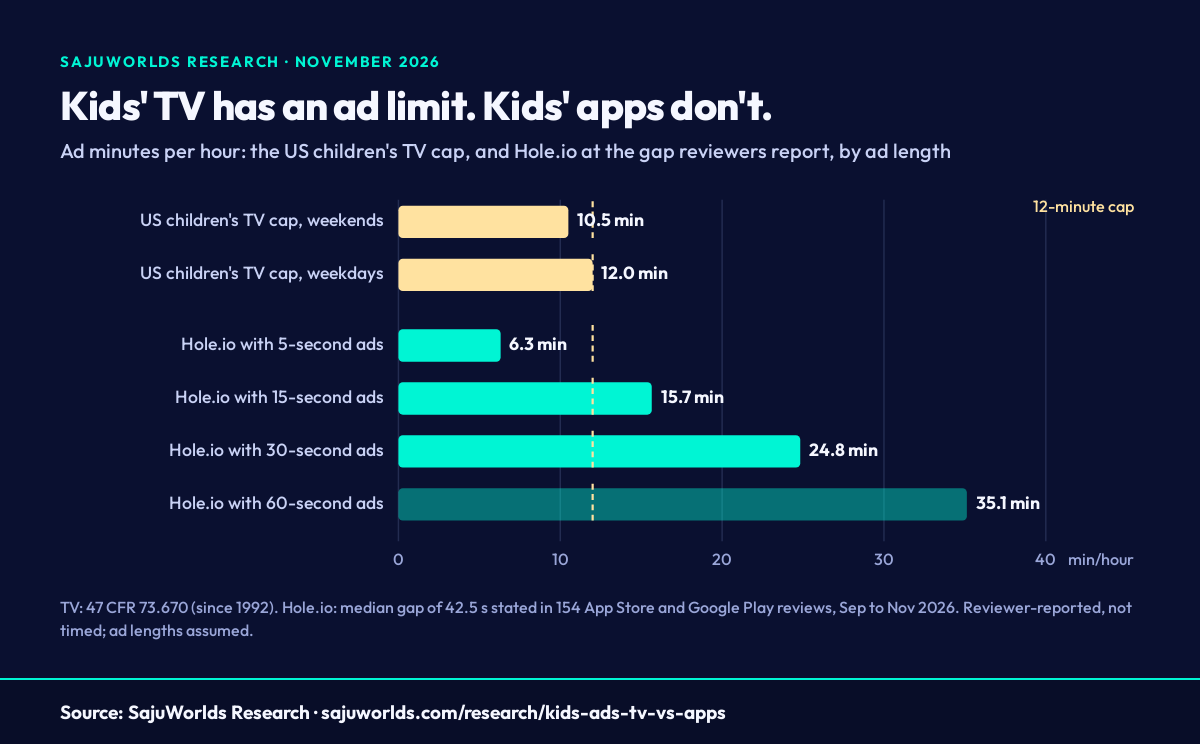
In 2024 the FCC upheld $3.3 million in fines over a toy ad inside a cartoon. No US rule limits ad time in apps
Since 1 January 1992, US broadcasters have been barred from showing more than 10.5 minutes of ads an hour in children's programming on weekends, or 12 on weekdays (47 CFR 73.670, under the Children's Television Act of 1990).
The biggest recent case: a commercial for a Hot Wheels toy aired 11 times during eight episodes of the cartoon Team Hot Wheels in late 2018. Because the ad was for a product tied to the show, each episode counted as a 30-minute ad. In 2024 the FCC upheld fines totalling $3,334,000, set at $20,000 per station (FCC 24-88). The stations settled in 2025: Sinclair for $500,000 covering this and other matters, the rest with compliance plans.
Smaller breaches are counted in seconds. In 2007 the FCC fined KRXI-TV in Reno $5,000 for 11 overruns, six of them five seconds long, and rejected "human error" as an excuse. A three-second web address shown after the preschool show Pocoyo was part of a 2025 Univision settlement of $300,000.
Apps have no equivalent. COPPA, the US children's privacy law, governs data, not ad time: its 2025 update still lets apps serve children contextual ads without parental consent, and names "cap the frequency of advertising" as an allowed use of identifiers. Apple says apps in its Kids Category "should not include third-party advertising", with exceptions, but nothing in its rules caps the number or minutes of ads. Google Play's family rules say an interrupting ad must be closable after 5 seconds, but set no limit on how often ads appear.
The catchApps are not broadcast TV, and the FCC rule does not apply to them. We use the TV cap as a yardstick, not as a law the apps break.
Reviewers say Hole.io shows an ad about every 40 seconds
Use this chart
Free to use with credit and a link to this page (CC BY 4.0).
<a href="https://sajuworlds.com/research/kids-ads-tv-vs-apps/"><img src="https://sajuworlds.com/research/kids-ads-tv-vs-apps/charts/holeio-ad-gaps.png" width="1200" alt="Time between ads stated in 154 Hole.io app-store reviews; the middle answer is 42.5 seconds"></a>
<p>Source: <a href="https://sajuworlds.com/research/kids-ads-tv-vs-apps/">SajuWorlds Research, "Kids' TV has an ad limit. Kids' apps don't."</a></p>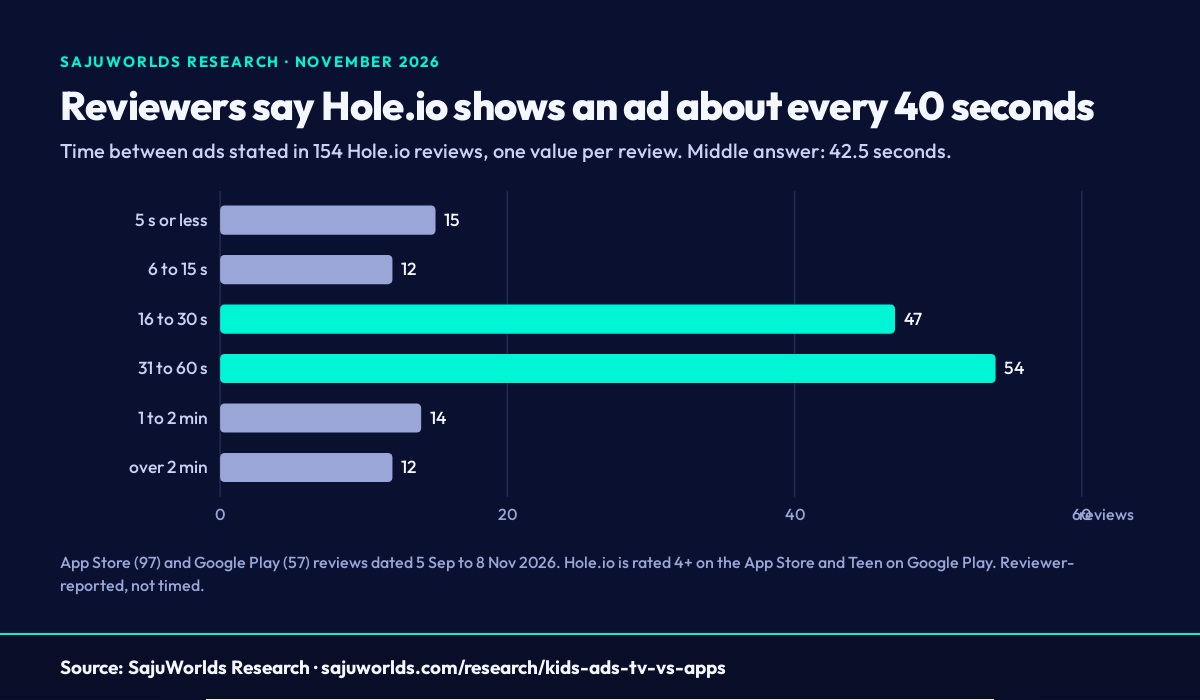
Among recent Hole.io reviews on the App Store (97) and Google Play (57), 154 state how often an ad appears. The middle answer is 42.5 seconds, and half fall between 30 seconds and a minute. Most of these reviewers are unhappy: 103 of the 154 give one star.
"There is literally one AD every minute. Like there is an actual timer that counts down to it."App Store review, 6 Nov 2026, 1 star
How much ad time that means depends on how long each ad runs, which we do not know. At a 42.5-second gap:
- 6.3with 5-second ads: under the TV cap
- 15.7with 15-second ads
- 24.8with 30-second ads
- 35.1with 60-second ads
Thirteen Hole.io reviews give the length of a single ad. Their middle answer is one minute, and they run from "3 to 10 second ads" to "a 5 minute AD"; two describe ads of 10 seconds or less. (Our scan flagged 25 length statements; 11 were misreads of the words "as ads", and one gave a session total, "10 min ads".) We show 5 seconds as the short case because that is when Google Play's family rules say an interrupting ad must become closable.
"It's fine if you can get past 3 to 10 second ads every literally 30 seconds. I timed it."Google Play review, 10 Oct 2026, 3 stars
Hole.io is rated 4+ on the App Store and Teen on Google Play. It is the only app in our data with a large, consistent body of these reports. We have no source on how many children play it.
The catchThese are user reports, not a measurement, and reviews over-represent annoyed players. If a stated gap already includes the ad, the true figure would be higher; if reviewers exaggerate, it would be lower. With short ads the same gap stays under the TV cap. Only a timed play-through can settle it.
We publish the reviewer-reported ad gap for 11 games, and set aside 9 more as exaggeration
Use this chart
Free to use with credit and a link to this page (CC BY 4.0).
<a href="https://sajuworlds.com/research/kids-ads-tv-vs-apps/"><img src="https://sajuworlds.com/research/kids-ads-tv-vs-apps/charts/ad-gap-by-game.png" width="1200" alt="Reviewer-reported gap between ads for 20 free mobile games, from app-store reviews"></a>
<p>Source: <a href="https://sajuworlds.com/research/kids-ads-tv-vs-apps/">SajuWorlds Research, "Kids' TV has an ad limit. Kids' apps don't."</a></p>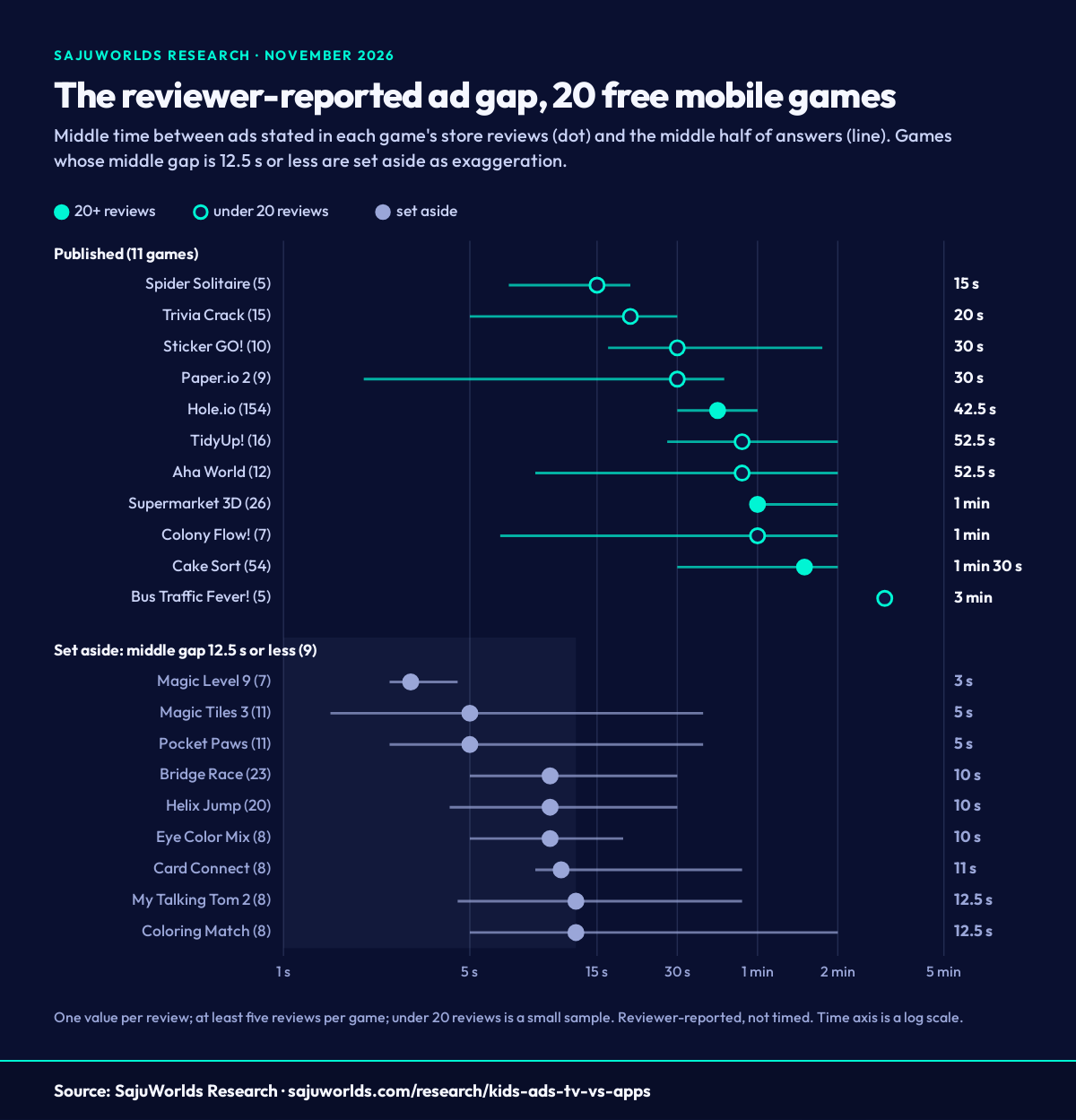
Twenty games have at least five reviews that state a time between ads. We publish a figure for 11 of them. For the other 9 the middle answer is 12.5 seconds or less, with answers such as "every second", so we treat it as exaggeration.
The rule we apply. One value per review (a review that gives several gaps counts once, at their middle). A game needs at least five such reviews. If its middle gap is 12.5 seconds or less, we print the gap but no ad minutes: at that gap even 15-second ads would fill more than half of every hour. Fewer than 20 reviews is marked as a small sample.
Download the data: ad gap for 20 games (CSV)The 154 Hole.io reviews (CSV)Hole.io ad lengths (CSV)
The catchBelow 20 reviews a single angry review moves the figure, so treat those rows as leads. Only Hole.io has a large, consistent body of reports. Aha World & Gabby's Dollhouse is the only Kids Category app in the table, on 12 reviews whose answers range from 1 second to 3 minutes.
Talking Tom's owner served about 28 billion full-screen ads in 2025, to players of all ages worldwide
Outfit7, maker of the Talking Tom games, is owned by Zhejiang Jinke Tom Cat Culture Industry, listed in Shenzhen. Its 2025 annual report counts 16.2 billion interstitial ads (the kind that fill the screen between moments of play) and 12.0 billion rewarded videos, 28.1 billion full-screen ads in all, plus 75.0 billion banners. Advertising was 73% of the company's revenue.
Dividing ad revenue by impressions, each full-screen ad earned about a quarter of a cent: roughly $2.33 per 1,000 interstitials and $2.77 per 1,000 rewarded videos. estimate
The catchThe ad counts cover all of the company's users, of all ages, worldwide, not only children. The per-ad figure is our estimate from reported revenue and impressions, converted from yuan at the 2025 average rate.
Five apps criticised in 2018 for tactics aimed at young children, four of them for ads or purchase prompts, carry Google's Teacher Approved badge
In 2018, child-advocacy groups and researchers named apps that used ads and purchase prompts on young children: a camouflaged present that leads to video ads, thought bubbles that unlock only after an ad, a character who cries if nothing is bought. Of the 11 of those apps that we could find on Google Play today, five carry Google's "Teacher Approved" badge, which makes them eligible for the store's Kids tab. For two of those five, the match to the 2018 app is probable, not certain.
The catchWe have not tested whether today's versions behave as described in 2018. Three of the 11 matches are probable, not certain. Two of the five badged apps, Strawberry Shortcake Bake Shop and Hello Kitty Lunchbox, have no recent ad complaints in our review scan.
Hole.io's developer lists 680 ad systems allowed to sell its ad space. The typical Kids Category developer lists none
Developers publish a public file, app-ads.txt, naming every company authorised to sell ads in their apps. Voodoo, which makes Hole.io, Paper.io 2 and Helix Jump, names 680 distinct ad systems across 14,945 lines. Outfit7's file names 451.
Among the developers behind the other popular free games in our list, the middle value is 359. Among developers of top Apple Kids Category games it is zero: 21 of 30 name none.
The catchThe file shows selling arrangements, not ads seen. It covers a developer's whole catalogue, not one game. Apple's rules restrict third-party ads in the Kids Category, so few entries there is expected.
What a UK regulator's test profiles were shown in 2024
In a study published in March 2025, the UK's Advertising Standards Authority reported that in 2024 its test profile registered as a girl born in 2009, so 14 or 15, was served an ad inside My Talking Tom 2 that Outfit7 told the ASA "had breached their own ad restrictions", and that was then removed.
The ASA built test profiles and recorded the ads they were served in 14 game apps from the end of February to May 2024. The profile it calls the "female child" was set up this way: "A Google ID was created with a 2009 date of birth" (p.8).
In My Talking Tom 2 that profile was served an ad for Perfect Lie in which "the teacher approached the blackboard and bent over, with her bottom appearing pixelated. Two options appeared: 'Look away' and 'Watch her A**'" (p.9). Outfit7 told the ASA the ad "had breached their own ad restrictions" and "was categorised under the 'game simulation' ad category and therefore avoided classification as containing prohibited themes." It "immediately contacted ironSource and told them to remove the ad and any similar ads, which they agreed to" (p.10). ironSource "re-reviewed and revised the moderation decision for the ad and blocked it from their platform" (p.10), and the advertiser "had removed the ad from all ad networks" (p.9).
Paper.io 2 was one of three games in which the ASA's test profiles, a teenage girl's and an adult man's, were served ads for a PEGI 16 dating sim (p.15). The report does not say which profile saw the ad in which game. Voodoo said the ad "had been categorised as 'games, entertainment, role play, simulation', which were broad categories that could circumvent the categories they prohibited. When the ad was identified, it was immediately blocked, and the advertiser was put on a block list" (p.16). It has since blocked the "role play" category and, since summer 2024, works with an ad-scanning company (p.16).
Across the study the ASA logged 5,923 ad impressions and found eight unique ads that objectified women. "All, save for one ad, were served to child avatar profiles. However, due to the small number of ads involved, this finding cannot be extrapolated as being statistically relevant" (p.3).
The catchOne study, in the UK, on Android only, in 2024, with each app watched for 5 to 10 minutes a day per profile, published in March 2025. The ASA says extrapolating to real-world exposure "must be avoided" (p.7). The "child" profile was a teenager's, not a young child's. Outfit7, ironSource, the Perfect Lie advertiser and Voodoo all told the ASA the ads had been removed or blocked.
Ad minutes per hour
Pick a game to use the gap its reviewers report, or set your own, then choose how long each ad runs. The line shows ad minutes per hour at every gap; the dashed lines are the US children's TV caps.
Game gaps are the middle gap stated in reviews; they are user reports, not measurements. Games marked "small sample" rest on fewer than 20 reviews. Formula: 60 × L ÷ (gap + L).
What did not hold up
Ad-time figures for every game
For 9 of the 20 games with at least five reviews stating a gap, the middle answer was 12.5 seconds or less, with answers such as "every second". That is exaggeration, so we publish no ad-time figure for them.
Ad complaints rising through 2026
An apparent rise was a sampling artefact: the newest few hundred reviews span weeks for busy games and years for quiet ones.
Ad complaints sink star ratings
Reviews that complain about ad load average 1.9 stars, against 3.9 for the rest. But a complaint is low-starred almost by definition, so this tells us nothing about the games.
What we could not test
Timing the ads ourselves
We played no games. A timed play-through of Hole.io on both stores is the test that would confirm or overturn the reviewers' figure.
Who plays, and who writes reviews
We cannot see reviewers' ages. Only 1 of the 1,100 Hole.io reviews we collected mentions the writer's children.
Ad software inside each app
The services that list ad software in apps blocked automated access. We used app-ads.txt instead, which shows who may sell ads, not what code is installed.
The 2018 apps today
Whether today's versions still use the tactics described in 2018. We checked listings and reviews only.
Method in plain words
We built a list of 193 free mobile games: the top free games in Apple's Kids Category, games named in published reports on what children use (such as Qustodio's 2025 report), and others from store charts. Hole.io came from Apple's 2025 list of top free iPad games in the US, as reported by 9to5Mac: a download ranking, not a measure of who plays. We collected store listings, public files and reviews on 10 and 11 November 2026. No company or person was contacted, and we played no games.
Sample
- 130,888 Google Play and App Store reviews across 191 of the 193 apps, mostly dated September to November 2026 for busy apps and earlier for quiet ones.
- From those, 2,040 statements about ad frequency in 110 apps: 906 say an ad follows each level or round, 540 give a time between ads, 450 were flagged as an ad length and 126 say there are more ads than game.
- The reviewer-reported ad gap uses one value per review and is published only where at least five reviews state a gap (20 games). For Hole.io, 154 reviews state one.
- Ad lengths for Hole.io: of 25 statements flagged, 13 give the length of one ad (11 were misreads, 1 a session total). Middle answer 60 seconds; range under 10 seconds to 5 minutes.
- 73,584 reviews of 99 core games coded by keyword. Any mention of ads: 3.1% of 40,284 reviews of Kids Category games and 12.6% of 33,300 reviews of other popular games. A narrower set, complaints about ad load (too many ads, unskippable ads, an ad after every level, "every 30 seconds"), is 1,315 reviews, 1.8% of all 73,584.
- Google Play listings and the newest 600 reviews of each of the 11 apps named in 2018.
Sources
- App stores: Apple App Store and Google Play listings and reviews.
- FCC: 47 CFR 73.670 and enforcement orders, including FCC 24-88 (Team Hot Wheels), DA 25-560 (Sinclair settlement), DA 07-3219 (KRXI-TV) and DA 25-647 (Univision). The 1 January 1992 start date is stated in DA 95-1806.
- UK ASA: Online ad supply pathway (March 2025). Quotes give the report's printed page numbers.
- FTC: amended COPPA Rule, 22 April 2025 (compliance date 22 April 2026). Apple: App Review Guidelines 1.3 and 2.5.18. Google: Google Play Families policies.
- Company filing: Zhejiang Jinke Tom Cat 2025 annual report; yuan converted at the FRED 2025 average of 7.1875 per dollar.
- app-ads.txt files on each developer's own website, fetched 10 Nov 2026.
- 2018 criticism: letter to the FTC from the Campaign for a Commercial-Free Childhood (now Fairplay), the Center for Digital Democracy and 20 other groups (30 Oct 2018); Meyer et al., Journal of Developmental & Behavioral Pediatrics 40(1), 2019; complaint on Google Play's family section (Dec 2018).
Limits
- The ad-time figures are what reviewers report, not what we measured. Reviews over-represent unhappy players, and we cannot see who wrote them.
- We do not know how long the ads run. We show 5, 15, 30 and 60 seconds; at 5 seconds Hole.io's reported gap stays under the TV cap.
- Store labels and ratings are set by developers and stores, and differ between stores: Hole.io is 4+ on the App Store and Teen on Google Play.
- The ASA study covers the UK, Android and three months of 2024.
SajuWorlds Research carried out this study. The analysis was done in-house by the people who own and run SajuWorlds.
Use this study
Cite this study
Please link to this study page, not the SajuWorlds home page: the figures, the method and the data are here. The reviewer-reported ad gap and the ad-minutes figures are our own analysis and appear only on this page.
Copy-ready lines
Download the data (CSV)154 Hole.io reviews (CSV)
Charts and data on this page are free to use under CC BY 4.0, with credit to SajuWorlds Research and a link to this page. Each chart marked "Use this chart" has embed code and a PNG.
Press: support@sajuworlds.com
Who made this study
SajuWorlds is a paid web app where children describe a game and AI builds it. It carries no ads, no third-party trackers and no selling inside the game.
See how it worksA SajuWorlds Research data study, November 2026. SajuWorlds Research is run by SajuWorlds, a paid, ad-free web app where kids describe a game and AI builds it.