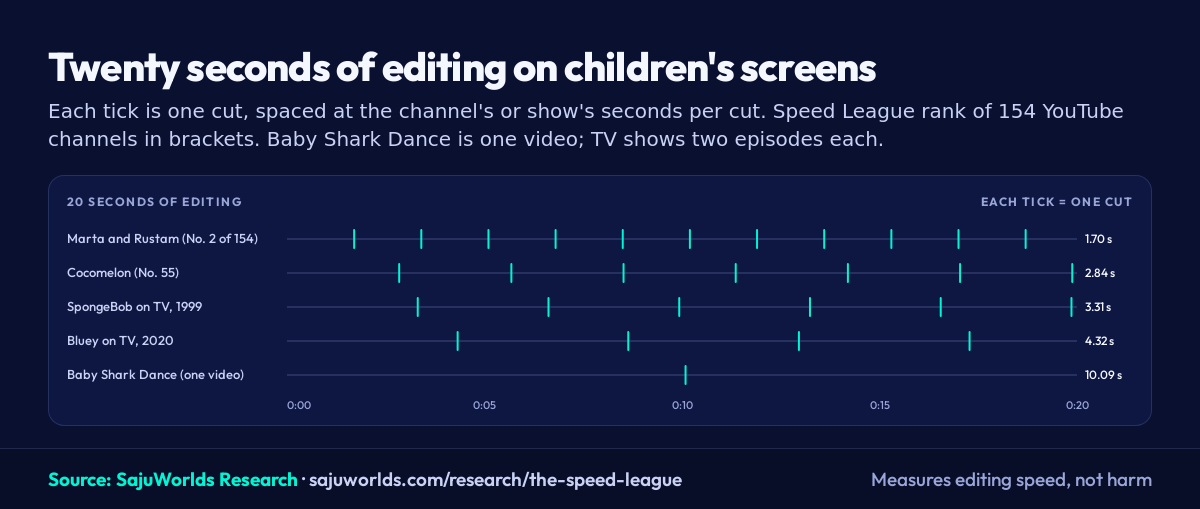
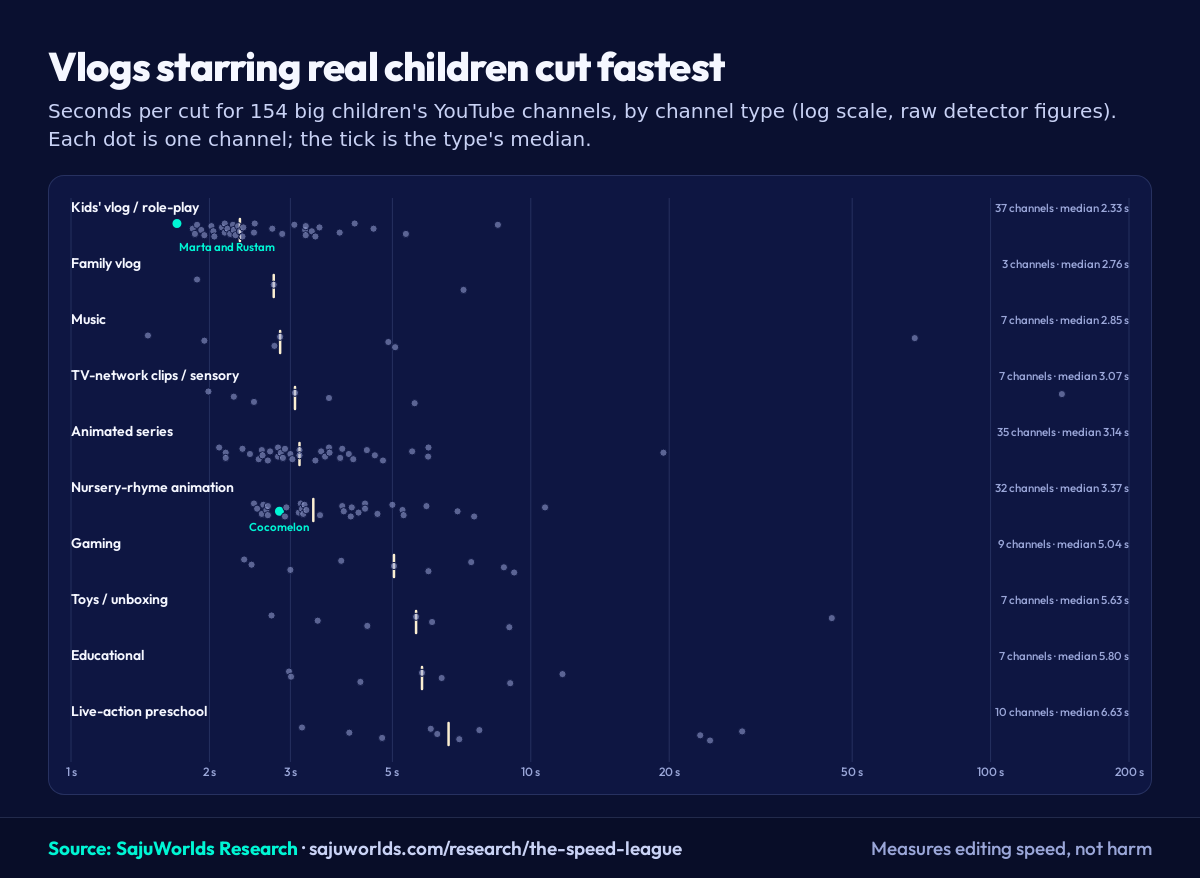
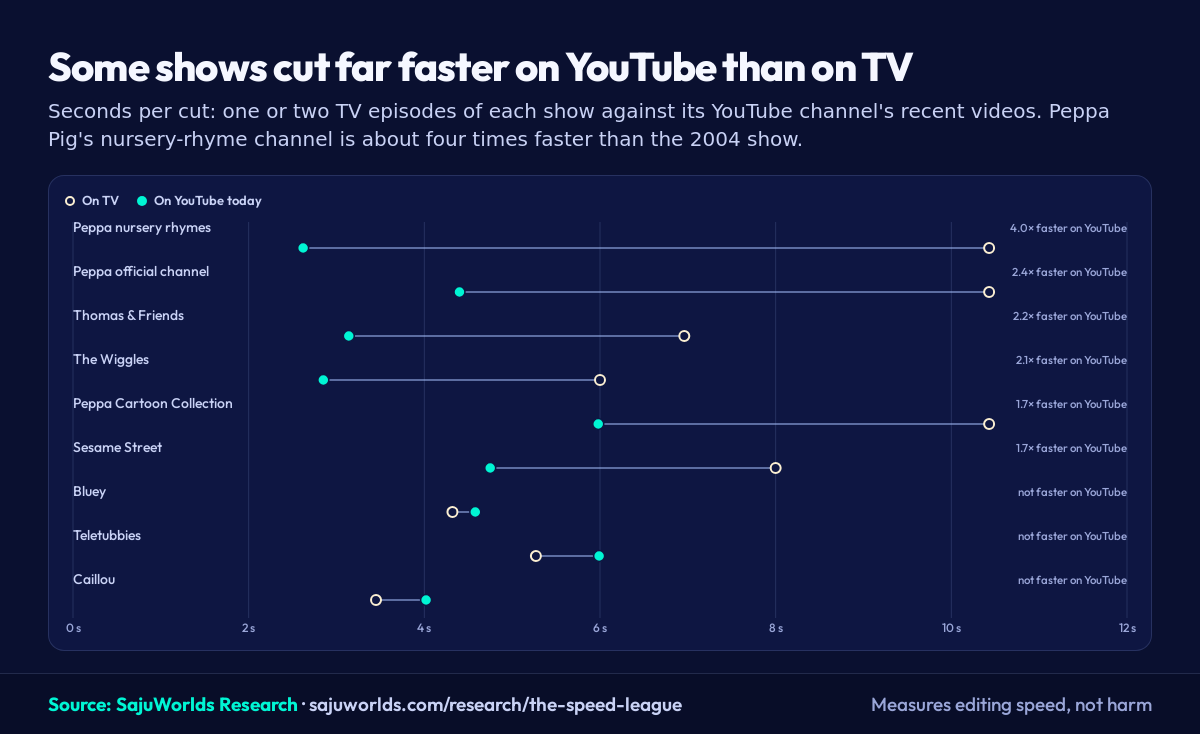
What we measured. Seconds per cut (also called average shot length): seconds of video divided by the number of shots. A channel's figure is the median across its measured videos, so one odd video cannot swing it. The ranges shown are 95% bootstrap intervals over videos.
Sample. 154 of the most-subscribed English-language children's YouTube channels (158 attempted; four could not be measured). For each channel we took its five newest uploads and the three most-viewed of its 400 newest, all between 1 and 20 minutes long, leaving out compilations, trailers and audio visualizers. Each channel rests on 5 to 11 recent videos: 1,181 videos, 143 hours and 154,517 complete shots. Measurement ran on 10 November 2026. A separate sample of the ten most-viewed videos of all time for 11 channels (used for Cocomelon, Little Baby Bum and Baby Shark Dance) is kept out of the league.
Channel types. Our own labels, from each channel's videos and description.
Detector. A frame-difference cut detector built on PySceneDetect, tuned on 33 hand-labelled TV clips. Videos were scaled to 240 lines and at most 30 frames a second; the first 5 and last 20 seconds were skipped and at most the middle 15 minutes measured.
Hand check. We marked every cut by eye in 61 windows from 58 videos (485 cuts). Almost every cut the software reported was real (97%), but it missed some, mostly cuts between similar shots, wipes and jump cuts. The share of real cuts it found, by channel type:
0.94animated series
0.87vlogs
0.79nursery animation
0.77gaming
0.76live-action
~0.5toys and educational
So the raw figures on this page understate speed, and true speeds are somewhat faster: the median channel is 3.23 seconds raw and about 2.80 seconds corrected. Rankings use the raw figures. Blippi was checked separately on 11 November 2026, one video each from Blippi Learns, Blippi Playtime and the main Blippi channel's all-time hits: the long takes are real. For Blippi Learns and Blippi Playtime, whose figures are above 20 seconds, exact figures may overstate by up to about 3 times; the other Blippi channels show their measured figures.
TV and film comparisons. 50 TV titles from 1941 to 2021, one or two episodes each, measured with the same detector from copies on the Internet Archive. Film, trailer and other figures are labelled as published or measured by us.
Words. 819 of the 1,181 videos had YouTube captions (85% automatic), 517,527 words. Counts include song lyrics.
Agreement. An independent 2026 study of 30 popular children's channels found 23.5 cuts a minute, about 2.55 seconds a shot (Söğütlüler, Acta Infologica). Our median channel is 3.23 seconds raw and 2.80 corrected, on a different sample.
What we could not test
- Any effect on children. Cut speed is a measure of editing; it says nothing about quality, learning or harm.
- What children actually watch. Lifetime views include autoplay and adult viewers and are not current viewing.
- A channel's whole catalogue. Each channel rests on 5 to 11 recent videos.
- The cuts the detector misses, channel by channel. We hand-checked 61 windows and the Blippi channels, not every channel, and skipped the first 5 and last 20 seconds of each video.
- The Sunday Times' method, which it did not publish.
Limits
- TV comparisons rest on one or two episodes per show.
- Ranks are close together; the typical channel's likely rank range spans about 40 places.
Sources
- YouTube: public videos, captions, view and subscriber counts.
- The Internet Archive: TV episodes and film trailers. archive.org
- UK Department for Education, new screen-time guidance for parents of under-5s, 26 March 2026. gov.uk
- The Sunday Times, Matilda Davies, "Think screens make your child ratty? This shows you may be right", 4 April 2026. thetimes.com
- Essex, Gliga, Singh and Smith, Infant Behavior & Development 66:101661 (2022), Table 2, including the Lillard and Peterson (2011) and Lillard et al. (2015) figures. PDF
- Cutting, Cognitive Research: Principles and Implications 1:30 (2016), film averages. PMC
- Söğütlüler, Acta Infologica 10(1):389-407 (2026). PDF
SajuWorlds Research carried out this study. The analysis was done in-house by the people who own and run SajuWorlds.